In the manufacturing world, "downtime" is the most expensive word in the dictionary. Whether it's a food processing plant, a pharmaceutical lab, or a heavy textile factory, the reliability of the utility infrastructure directly dictates profit margins. Industrial MEP is not about aesthetics; it is about absolute resilience, redundancy, and efficiency. At KHEBRAAT, we've helped Egyptian manufacturers cut unplanned downtime by up to 60% through strategic infrastructure investments that pay for themselves within months.
Understanding the True Cost of Downtime
Before diving into solutions, let's quantify the problem. A typical manufacturing line in Egypt's industrial zones costs between $5,000 to $50,000 per hour when idle, depending on the industry. For pharmaceutical plants, regulatory documentation of downtime events can delay product release by weeks. For food processing facilities, an unplanned refrigeration failure doesn't just stop production—it destroys inventory worth millions.
The root causes of industrial downtime consistently trace back to three infrastructure categories: electrical system failures (accounting for 35% of incidents), HVAC and cooling failures (30%), and utility system issues including compressed air and steam (25%). The remaining 10% stems from miscellaneous causes including human error and external factors.
Industry Downtime Costs (Per Hour)
- • Automotive Manufacturing: $20,000 - $50,000
- • Food Processing: $10,000 - $30,000
- • Pharmaceutical Production: $50,000 - $100,000
- • Textile Manufacturing: $5,000 - $15,000
- • Electronics Assembly: $15,000 - $40,000
Power Reliability: The Foundation of Production
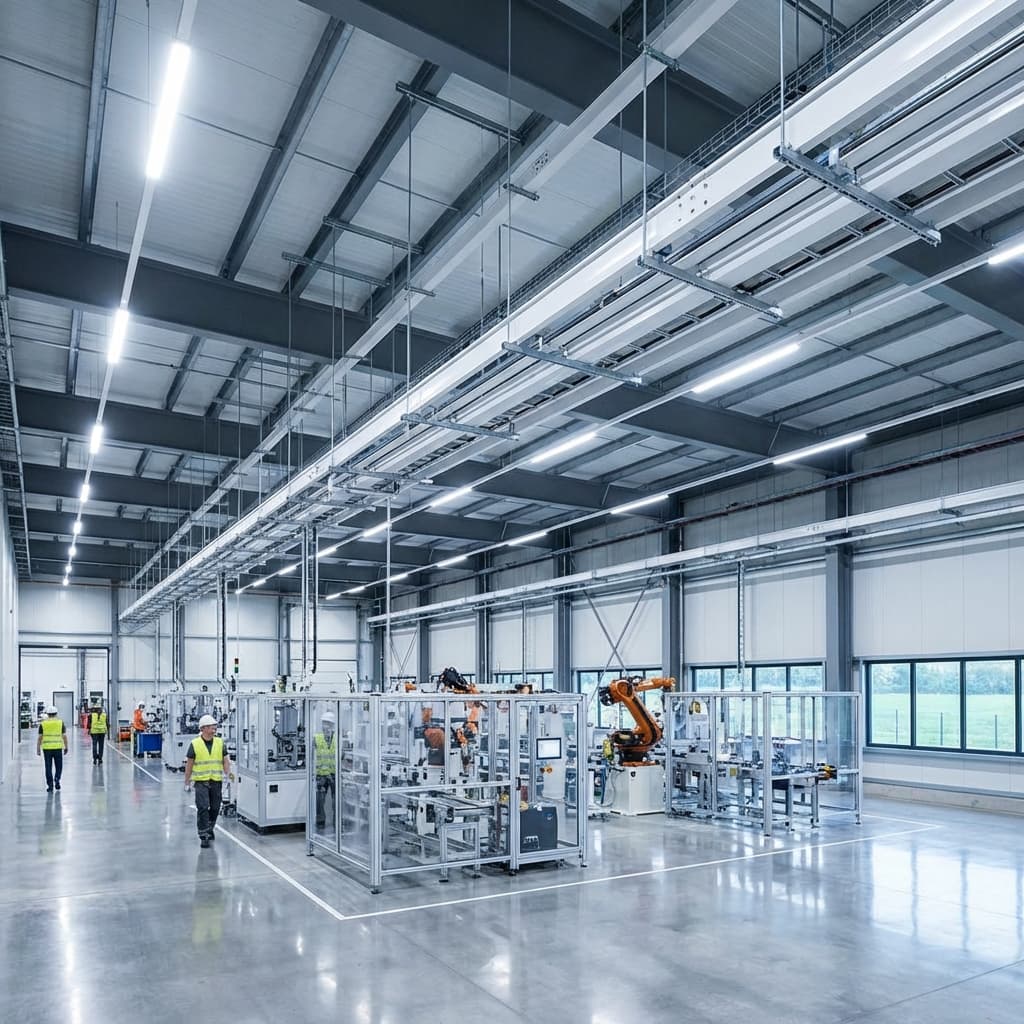
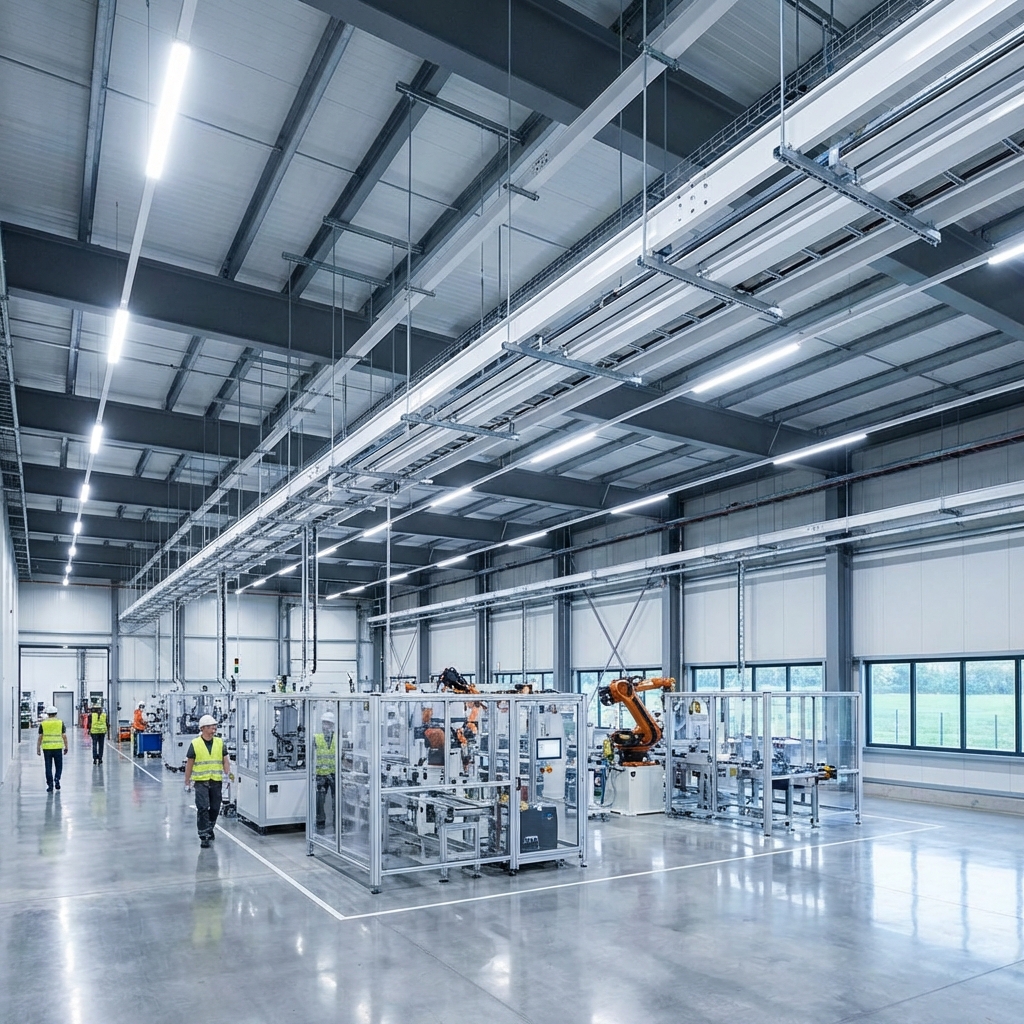
Inconsistent voltage or harmonic noise can wreak havoc on CNC machines and robotics. Traditional cabling often fails under the stress of modern heavy machinery and provides poor flexibility for production line reconfiguration. We advocate for overhead busbar trunking systems in industrial setups. They offer:
- Flexibility: Machines can be moved or added without rewiring the entire floor; you simply plug into the busbar at a new location.
- Safety: Reduced risk of cable overheating and lower fire load compared to multiple cable trays.
- Maintenance: Plug-in durability that allows for live maintenance in some configurations, avoiding plant shutdowns.
- Efficiency: Lower voltage drop over long distances, typically 50% less than equivalent cable runs.
Power Quality Management
Modern manufacturing equipment is highly sensitive to power quality issues. Variable frequency drives (VFDs), which are essential for motor control and energy savings, can inject harmonics back into the electrical system. Left unmanaged, these harmonics cause transformer overheating, capacitor failures, and unexplained equipment malfunctions.
Our industrial electrical designs incorporate active harmonic filters and careful load balancing to maintain Total Harmonic Distortion (THD) below 5%. We also specify surge protection at multiple levels—from the main switchgear to individual sensitive equipment—to guard against Egypt's frequent power grid transients.
Emergency Power Systems
Uninterruptible Power Supply (UPS) systems and standby generators are not optional in Egyptian manufacturing—they're essential. Our approach involves tiered backup strategies based on criticality analysis. Tier-1 equipment (production control systems, safety systems) receives instant UPS protection with 15-30 minutes of battery runtime. Tier-2 equipment (production lines, refrigeration) transfers to generator power within 10-15 seconds via automatic transfer switches. Tier-3 equipment (lighting, HVAC) can tolerate brief interruptions.
Process Cooling & Industrial Ventilation
Machines generate heat. Workers generate heat. The Egyptian summer generates heat—often exceeding 45°C ambient temperatures in industrial zones. Without effective management, this heat leads to machine tripping, product quality degradation, and worker fatigue that impacts productivity and safety. Effective Industrial Ventilation is crucial.
We are implementing displacement ventilation strategies in high-bay factories. Instead of mixing cool air with hot air at the ceiling (which is inefficient), we introduce cool air at low velocity near the floor. This creates a "lake" of cool air for workers and machines, while heat naturally rises and is extracted at the roof. This stratification approach is proving 40% more energy-efficient than traditional mixing ventilation.
Process Chilled Water Systems
Many industrial processes require precise temperature control—injection molding, pharmaceutical reactors, food processing lines. Process chilled water systems operate independently from comfort cooling, often requiring temperatures as low as 7°C with tight tolerances of ±0.5°C. Our designs incorporate redundant chillers in N+1 configurations, ensuring that the failure of any single unit doesn't impact production.
We also specify variable primary flow systems with modulating valves at each process point. This approach reduces pumping energy by 30-50% compared to constant flow systems while maintaining precise temperature control at each use point.
Utility Grade Compressed Air & Steam
Beyond electricity and cooling, the "other" utilities—compressed air, steam, and chilled water—are the veins of a factory. Leaks in compressed air systems are incredibly common and costly. Our industrial audits often reveal that 20-30% of compressor energy is lost to leaks. Designing distinct, zoned loops with isolation valves and flow monitoring is critical for identifying and fixing these invisible cost sinks.
Compressed Air Quality Standards
Not all compressed air is created equal. Food and pharmaceutical applications require ISO 8573-1 Class 1.2.1 air—essentially instrument-grade air free of oil, moisture, and particulates. General manufacturing might accept Class 2.4.2. Our designs segment these requirements, providing high-quality air only where needed while delivering standard air to general pneumatic tools, optimizing both capital and operating costs.
Steam System Efficiency
For textile, food processing, and pharmaceutical plants that require steam, boiler efficiency and steam trap maintenance are critical cost factors. Modern condensing boilers achieve 95%+ efficiency compared to 80% for older atmospheric boilers. Equally important, we implement steam trap monitoring systems—a single failed steam trap can waste $5,000+ annually in lost energy.
Fire Protection for Industrial Facilities
Industrial facilities present unique fire protection challenges. High-bay warehouses require Early Suppression Fast Response (ESFR) sprinklers. Chemical storage areas need specialized suppression systems. Production areas with sensitive equipment may require pre-action systems that prevent accidental water discharge.
Our approach integrates fire detection with process control. Upon detecting smoke in a painting booth, for example, the system not only alerts operators and activates suppression but also shuts down the spray equipment and activates emergency ventilation—a coordinated response that minimizes both fire damage and production impact.
Predictive Maintenance Integration
The most reliable plant is one that predicts failures before they occur. We design industrial MEP systems with extensive monitoring points—vibration sensors on rotating equipment, thermal imaging ports for electrical panels, flow meters on utility systems, and building management system (BMS) integration that trends performance data over time.
This data enables condition-based maintenance rather than calendar-based maintenance. Instead of replacing motor bearings every 12 months regardless of condition, the system alerts technicians when vibration signatures indicate wear—often identifying problems weeks before failure would occur.
Key Takeaway: Prevention Economics
Every $1 invested in predictive maintenance systems returns $4-$10 in avoided emergency repairs and prevented production losses. The ROI is even higher when you factor in avoided quality defects caused by equipment operating outside optimal parameters.