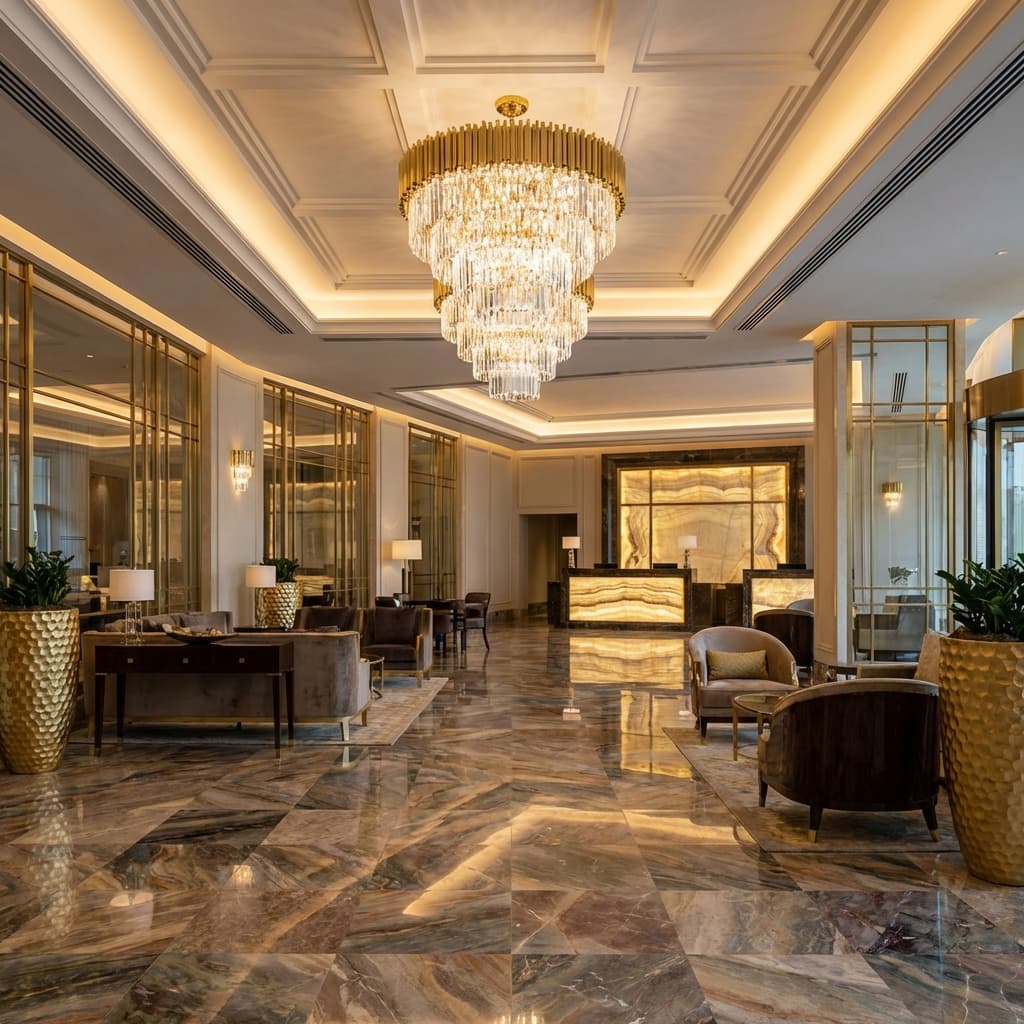
In the hospitality sector, guest comfort is paramount. A guest pays for an experience, an ambiance, and a feeling of ease. However, the systems that provide this comfort—massive chillers, powerful pumps, complex ductwork—are inherently noisy and intrusive. The art of MEP engineering in luxury hotels is "invisibility." If the guest notices the air conditioning, we have failed. At KHEBRAAT, we've perfected the balance between engineering necessity and aesthetic invisibility across dozens of hospitality projects in Egypt.
The Guest Experience Equation
Before diving into technical solutions, let's understand what guests actually experience. The moment a guest enters a hotel room, their senses are engaged in ways they may not consciously register. The temperature is perfect—not too cold, not too warm. The air smells fresh, not stale. There's complete silence—no humming, no whooshing, no vibrations from the floor below. The lighting adjusts naturally as daylight fades. Hot water appears instantly when they turn the tap.
Each of these seemingly simple experiences requires sophisticated engineering. Achieving them invisibly—without exposed ducts, visible thermostats, or audible equipment—is what separates a true 5-star experience from a good hotel. This is where the MEP engineer becomes as important as the interior designer.
The Economics of Invisible Comfort
Studies show that HVAC-related complaints are the #1 cause of negative hotel reviews. A single one-star review can cost a luxury hotel $50,000+ in lost bookings over a year. Investment in proper MEP engineering isn't an expense—it's revenue protection.
Acoustic Engineering: Silence is Luxury
A humming AC vent or a vibrating pipe can ruin a guest's sleep and lead to negative reviews. We employ advanced acoustic attenuation techniques from the design stage. This involves:
- Velocity Control: Sizing ducts effectively to keep air velocity below 3 m/s, which eliminates "whooshing" sounds at the grille. This often means ducts 20-30% larger than minimum code requirements.
- Vibration Isolation: Mounting all mechanical equipment on spring isolators and floating floors to ensure no structural noise is transmitted to guest rooms. We specify housekeeping pads with 95%+ isolation efficiency.
- Sound Traps: Installing attenuators in ductwork between machinery spaces and occupied areas. Multiple silencers in series achieve better results than single larger units.
- Structural Separation: Mechanical rooms are never located directly adjacent to or above guest rooms. When unavoidable, we use room-in-room construction with decoupled walls and ceilings.
Understanding NC Ratings
Noise Criteria (NC) is the industry standard for measuring background noise in occupied spaces. For context:
- NC-25 to NC-30: Required for luxury hotel guestrooms—this is near silence, with only the softest background hum
- NC-35 to NC-40: Acceptable for restaurants and public areas where conversation masks equipment noise
- NC-40 to NC-45: Appropriate for hotel kitchens and back-of-house areas
Achieving NC-30 in a guest room while providing adequate fresh air and temperature control requires careful coordination of duct sizing, diffuser selection, and equipment placement—all decisions made months before construction begins.
Aesthetic Integration: Engineering in Service of Design
Architects hate access panels. Interior designers despise bulky thermostats and smoke detectors that break the visual rhythm of a ceiling. We collaborate early with design teams to solve these conflicts—our HVAC solutions are designed around aesthetics from day one.
Hidden Air Distribution
We utilize linear slot diffusers that can be painted to match the ceiling or hidden within architectural coves. In premium suites, we've implemented underfloor air distribution where conditioned air rises gently from the floor, completely eliminating ceiling penetrations. We locate sensors within joinery work or behind decorative grilles. Our integration ensures that the guest enjoys perfect thermal comfort without ever looking up and seeing a metal box.
Invisible Fire Safety
Fire protection systems present unique aesthetic challenges. Sprinkler heads must be visible for code compliance, but they don't have to be ugly. We specify concealed sprinklers with cover plates that match ceiling finishes—flush-mounted and nearly invisible until activated. Smoke detectors can be specified in custom finishes or integrated into lighting fixtures where permitted by code.
Smart Control & Guest Room Management
Future luxury is about personalization. Guest Room Management Systems (GRMS) allow guests to control lighting, temperature, and curtains from a single tablet or their smartphone. For the hotel operator, these systems automatically revert to "Eco Mode" when the guest leaves the room, saving vast amounts of energy without compromising the guest experience upon their return.
The Intelligence Behind Comfort
Modern GRMS systems go far beyond simple on/off control. They learn guest preferences—if Mr. Ahmed consistently adjusts his room to 22°C, the system remembers this for his next stay. They predict occupancy from reservation data and pre-condition rooms before arrival. They integrate with key card systems to detect presence and occupancy modes.
For hotel operators, the energy savings are substantial. A typical 200-room hotel can save 15-25% on energy costs through intelligent GRMS implementation—often $100,000+ annually. The system also provides maintenance alerts, identifying rooms with HVAC issues before guests complain.
Plumbing Luxury: Instant Hot Water & Pressure
Nothing disappoints a luxury hotel guest faster than waiting for hot water or experiencing weak shower pressure. Our plumbing designs for hospitality incorporate:
- Hot Water Recirculation: Continuous loops ensure hot water reaches every fixture within 5 seconds. We specify dedicated return lines, not just relying on the cold water pipe as a return path.
- Pressure Consistency: Variable speed pumps maintain constant pressure regardless of demand fluctuations. A guest on the 20th floor gets the same shower experience as a guest on the 3rd floor.
- Whisper-Quiet Fixtures: Toilet flush mechanisms and faucets are specified for minimum noise generation. Concealed cisterns are wrapped in acoustic insulation.
- Drainage Silencing: Soil stacks are wrapped in acoustic lagging, and special cast-iron pipes replace PVC in noise-sensitive locations.
Water Features & Specialty Plumbing
Luxury hotels often feature dramatic water elements—infinity pools, lobby fountains, spa hydrotherapy circuits. These require specialized MEP engineering:
- Pool Dehumidification: Indoor pools generate massive humidity loads that can damage finishes and create condensation. We design dedicated dehumidification systems that maintain 50-60% RH while recovering heat from the process.
- Fountain Mechanics: The pump rooms behind decorative fountains require careful acoustic design—guests enjoy the water sounds, not pump noise. Variable frequency drives enable dynamic water effects.
- Spa Water Treatment: Hydrotherapy pools, hammams, and whirlpools each have unique water quality requirements. Our designs incorporate appropriate filtration, chemical treatment, and temperature control for each application.
Kitchen & Back-of-House Excellence
While guests never see them, hotel kitchens represent some of the most demanding MEP challenges. A hotel kitchen generates enormous heat, steam, and grease—all of which must be managed without affecting front-of-house areas.
Our kitchen ventilation designs include demand-controlled exhaust hoods that adjust fan speed based on actual cooking activity, make-up air systems that prevent negative pressure (which would pull odors into dining areas), and UV grease filtration that reduces fire risk and duct cleaning frequency. These systems integrate with our electrical infrastructure to ensure kitchen equipment has the power it needs without affecting other hotel systems.
Key Takeaway
The best MEP engineering in hospitality is the engineering you never notice. When guests describe a hotel as "peaceful," "comfortable," or "relaxing," they're often unconsciously describing excellent MEP design. Our goal is to be invisible—and invaluable.
